Supervising on Foot Within 300 Feet
Idaho’s 300-foot supervision rule can be easy to misread: it does not simply say that a young rider needs an adult somewhere nearby. The rule applies to certain roads and specifies who may supervise and how close an adult on the ground must stay. Here’s how to understand that requirement, prepare for a ride, and avoid treating it as permission to ride anywhere.
What Idaho’s 300-foot rule requires
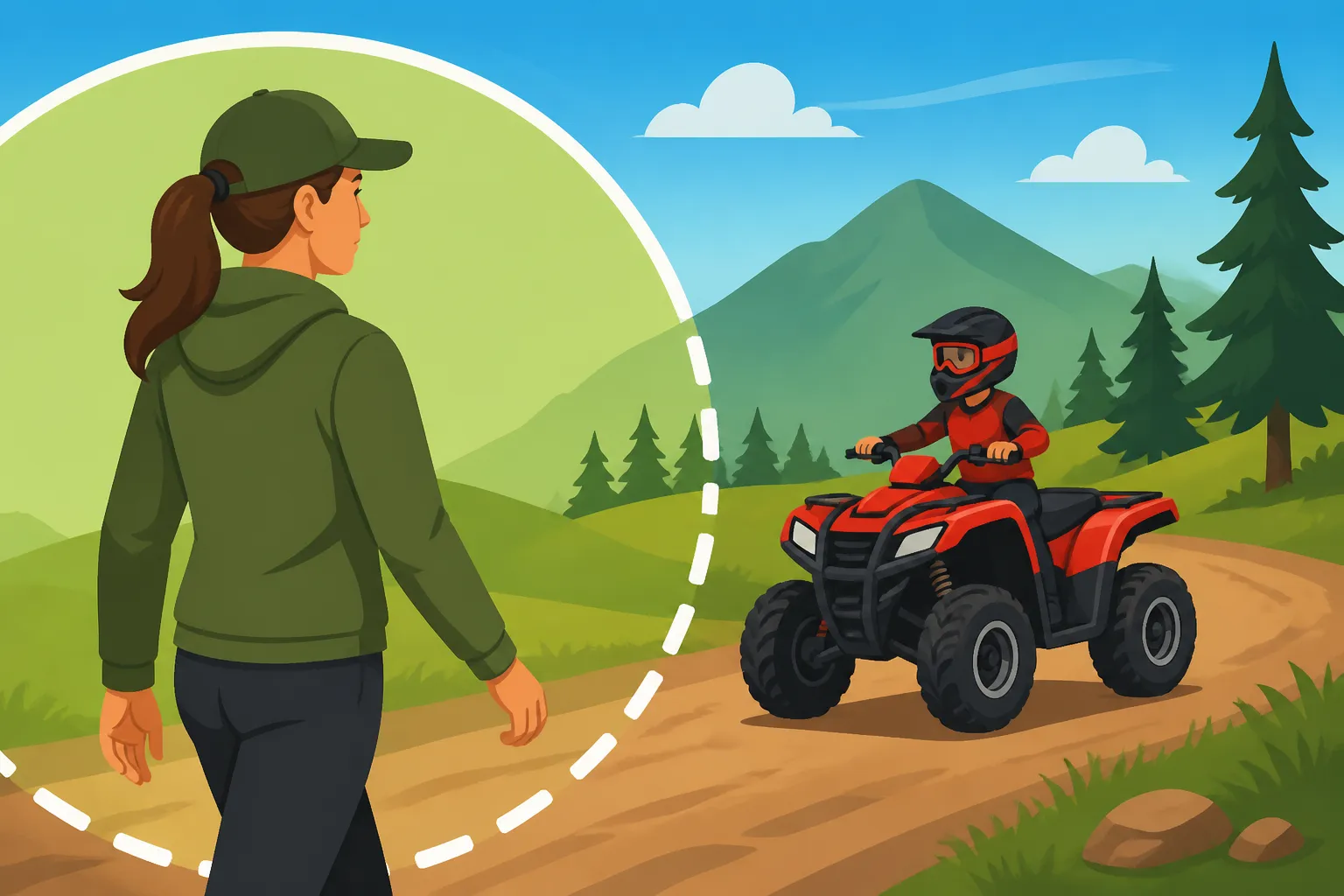
According to the Idaho Department of Parks and Recreation, Idaho Code 49-302 requires a person under sixteen operating an ATV, UTV, specialty off-highway vehicle, or motorbike on certain roads to be supervised by a licensed adult operator who is eighteen or older. When the supervising adult is on the ground, that adult must remain within 300 feet of the unlicensed operator.
The key details are the rider’s age, the adult’s qualifications, the type of road, and the adult’s location. The rule is not a general statement that any adult can supervise from any distance. Nor does the 300-foot distance mean the adult can be far away and uninvolved. It sets a distance limit for an adult supervising on foot.
| Question | What the rule says |
|---|---|
| Which young operators does it cover? | A person under sixteen operating a listed OHV on certain roads |
| Who can supervise? | A licensed adult operator who is eighteen or older |
| How close must an adult on foot stay? | Within 300 feet of the unlicensed operator |
| Does it apply to every road or trail? | The rule refers to certain roads; check the rules for the specific route |
The word “certain” matters. A county road, a road on federal land, a road inside a town, and a trail may be governed by different access rules. Meeting the supervision requirement does not, by itself, establish that the route is open to OHVs or that the machine may be operated there. Check the applicable route rules before setting out; What Idaho Requires to Ride a County Road and Idaho Rules on Forest Service Roads cover some of those separate questions.
It is also important to distinguish the adult’s physical location from the adult’s responsibility. Being within 300 feet is a distance requirement, not a guarantee that the young operator is ready for the route or that the adult can help quickly in every situation. Supervision should account for the terrain, traffic, visibility, the rider’s ability, and whether the adult can stay engaged while on foot.
For a more focused overview of the topic, see Idaho Supervision Rules and the 300-Foot Rule. For youth-specific road considerations, Idaho Rules for Riders Under 16 on Roads is also relevant.
What “on foot” means in practice
The rule expressly addresses an adult who is on the ground. That makes it useful to plan how the adult will keep close enough to supervise while the young person operates the machine. An adult walking alongside a moving OHV may not be practical or safe on many routes, so do not assume that the legal distance alone makes a route suitable for this setup.
The facts provided for the rule establish the maximum distance but do not specify a measurement method or detailed roadside procedure. If a route or situation raises doubt about how the requirement applies, confirm the interpretation with the Idaho Department of Parks and Recreation or the appropriate land manager before riding.
Keep supervision active, not just close
A responsible plan should make it possible for the adult to see or otherwise monitor what the young rider is doing, communicate clearly, and intervene if needed. Those are safety practices, not additional distance rules. A young rider who disappears around a blind bend, enters traffic, or moves onto a different route may be difficult to supervise effectively even if the starting arrangement was within the required distance.
Before riding, agree on where the young person may travel and when they must stop and wait. Choose a route where the adult can remain nearby without walking in a vehicle’s path or placing themselves in a hazardous position. If the adult cannot keep the rider under effective supervision, stop and choose a safer arrangement.
The machine and route should also suit the rider’s ability. A child’s age alone does not tell you whether they can control a particular ATV or handle a road segment. Idaho’s Department of Parks and Recreation lists recommendations for ATV engine sizes and rider ages, but those recommendations are not a substitute for choosing a machine the rider can operate safely. See Youth Machine Size Rules Idaho Parents Ask About for related guidance.
Do not confuse nearby presence with legal qualification
The supervising person must be a licensed adult operator who is eighteen or older under the rule described by the Idaho Department of Parks and Recreation. A person who is merely an adult companion may not meet that requirement if they do not meet the specified qualifications.
If the adult is riding another machine, the rule about an adult “on the ground” does not describe that arrangement. Do not assume that riding nearby automatically satisfies the on-foot provision. Check the applicable requirements for the route and the rider’s circumstances before relying on a different supervision setup.
The rule also concerns supervision on certain roads, not a broad exemption from other requirements. The route may have separate restrictions, and the young operator may have additional education or equipment requirements. Supervision should be one part of the pre-ride check, not the only item.
Check the route and the rider’s other requirements
A road’s appearance does not tell you whether OHV travel is allowed. Public lands can have restrictions, and roads or trails within National Forest boundaries may be subject to motor vehicle use limits. The Idaho Department of Parks and Recreation advises users to obtain a Motor Vehicle Use Map for access information and to inquire with the local Forest Service office when they need guidance. Permission is required before entering private land.
Before leaving, confirm that the route is open to the machine and that local restrictions do not change the plan. A map can help with route planning, but it should not be treated as a guarantee that every road shown is open to motorized use. For the broader road-access checklist, see Which Idaho Roads Are Open to OHVs and Idaho City and County Ordinances That Close Roads.
The young rider’s education status also matters on some routes. According to the Idaho Department of Parks and Recreation, an unlicensed operator under sixteen on a National Forest road must have completed an IDPR-approved OHV safety course. That is a separate requirement from the adult-on-foot distance rule. An adult within 300 feet does not replace the required course.
Idaho’s Department of Parks and Recreation provides the Responsible Riders course. The course is offered for ages six and up, and completion meets Idaho’s OHV education requirement outlined in Idaho Code 49-302. The Department says a parent must be present for riders under sixteen taking the course. Participants need to bring their own ATV with a current IDPR registration sticker, and sharing an ATV during the course is not allowed. Those course details do not change the requirement for a licensed adult supervisor on an applicable road.
Course participants must also bring the required riding gear. The Department requires a DOT-approved helmet, goggles or a face shield, over-the-ankle boots, OHV-type riding gloves, long pants, and a long-sleeved shirt or jacket during training. Check the course information before attending in case the instructions for a particular session provide additional details. The related pages Idaho’s OHV Safety Course for Young Riders and Who Must Take the Idaho Safety Course can help with course planning.
Keep the following distinctions clear:
- Supervision: A licensed adult operator who is eighteen or older must supervise a person under sixteen on the roads covered by the rule. If the adult is on the ground, the adult must remain within 300 feet of the unlicensed operator.
- Education: A course may be required for an unlicensed operator under sixteen on a National Forest road.
- Access: A route must be open to OHV use, and land-specific restrictions still apply.
- Permission: A rider must obtain permission before entering private land.
- Registration or permit: Applicable OHV registration and permit rules still apply, independently of supervision.
Checking each item separately is more reliable than assuming one requirement covers the others. A supervised rider may still be on a closed route, lack a required course, or need a valid registration sticker.
A practical pre-ride plan for an adult supervising on foot
A short plan can help keep the ride manageable and make it easier to follow the rule. Use it before the machine starts moving, especially if the group includes a young operator who has limited experience on roads.
- Confirm the route. Identify the road or route you plan to use, then check whether OHVs are permitted there. Review the land manager’s current access information and any local restrictions. Do not enter private land without permission.
- Confirm the rider’s requirements. Check the rider’s age, license status, and whether an approved safety course is required for the route. If the route is a National Forest road and the operator is unlicensed and under sixteen, the Idaho Department of Parks and Recreation says the rider must have completed an IDPR-approved OHV safety course.
- Choose a workable supervision position. Plan where the adult on foot can stay within 300 feet while remaining in a safe place and keeping the young rider under active supervision. If terrain, traffic, or route layout makes that impractical, do not proceed with that setup.
- Agree on boundaries and signals. Explain where the rider may go, when to stop, and how to respond if they lose sight of the adult or are unsure what to do. Keep the directions simple and discuss them before entering the route.
- Check the machine and equipment. Make sure the machine is suited to the rider and that required safety equipment is available. For course training, the Idaho Department of Parks and Recreation specifies a DOT-approved helmet and the listed protective clothing and gear.
- Reassess as conditions change. A route that is manageable at the start may become unsuitable if visibility worsens, traffic increases, the rider becomes tired, or the adult can no longer stay close and attentive. Stop rather than stretching the rule or relying on distance alone.
Registration and route preparation are separate from supervision, but they belong in the same pre-ride routine. The Idaho Department of Parks and Recreation says OHV registrations can be purchased online, in person at vendors, or over the phone. It also says registrations and permits are valid statewide, while designating a use area when permitting a vehicle does not limit use to that area. Statewide validity does not mean every route is open, so continue to check local access restrictions.
Make sure the machine displays the required registration sticker in the correct place. According to the Idaho Department of Parks and Recreation, ATVs, UTVs, and specialty off-highway vehicles must place the IDPR OHV recreational permit sticker on the rear fender. For more on route access and what to have ready, see Four Things Idaho Riders Must Carry on a Road.
The safest reading of the 300-foot rule is straightforward: it gives a limit for an adult supervising on foot, but it does not make every road suitable, replace a course requirement, or remove the need to verify access. Confirm the route, rider qualifications, and supervision plan before the young operator begins.
Sources
- Department of Parks and Recreation — ATVs, UTVs & Motorbikes | Department of Parks and Recreation (checked November 3, 2026)
- Idaho Department of Parks and Recreation — All Terrain Vehicle – (ATV) Course ID:1004 (checked November 3, 2026)
- University of Idaho Extension — FINAL-OHV-ECON-STUDY-SUMMARY-1.pdf (checked November 3, 2026)
- Idaho Department of Parks and Recreation — ID_OHV_LE_Guide.pdf (checked November 3, 2026)
Disclaimer
This article is for general informational purposes only and does not constitute professional advice. Laws, prices and regulations vary by location and change over time. Consult a qualified professional for guidance on your specific situation.