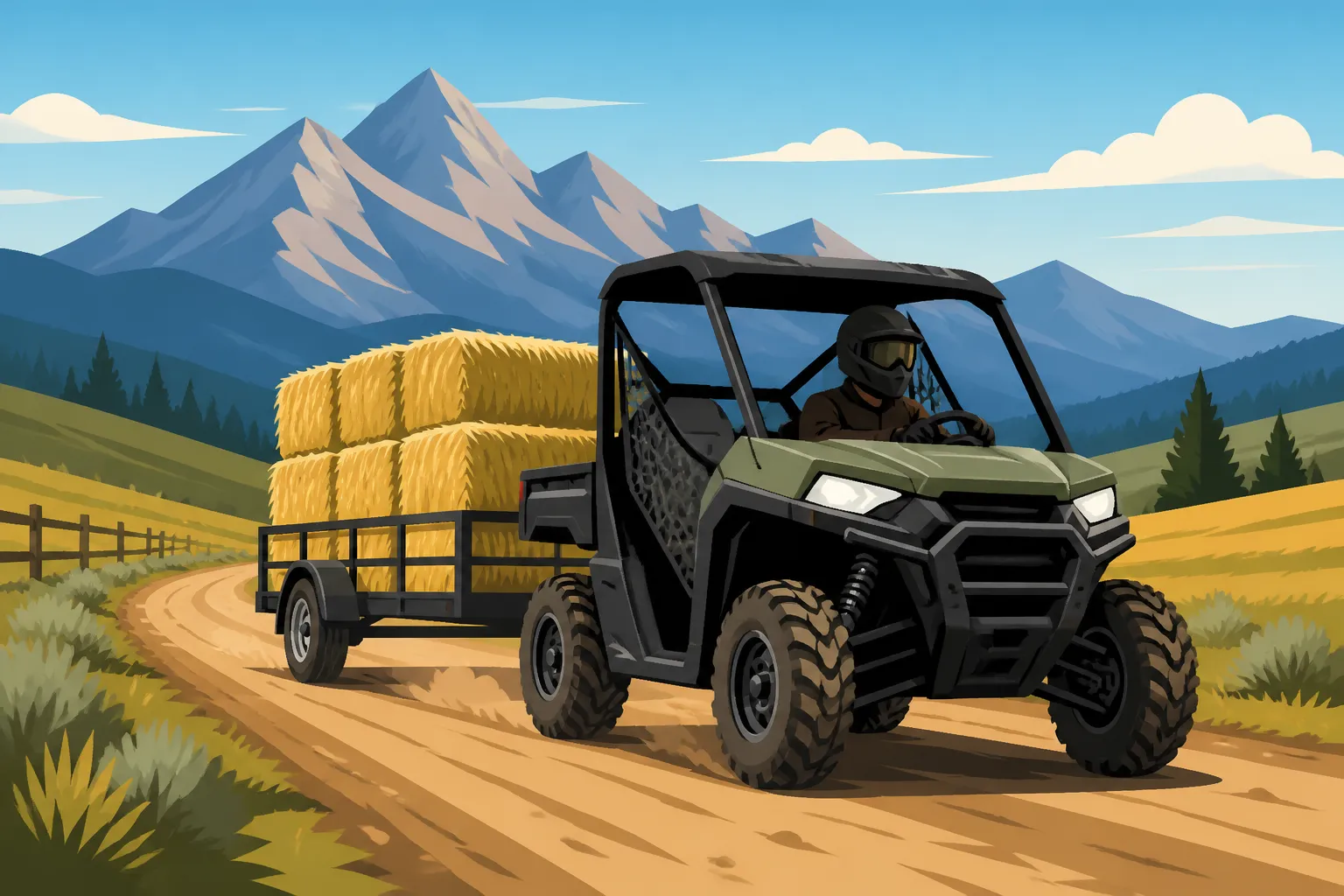
Hauling Hay by UTV on a Back Road
Picture this: you've got a utility vehicle (UTV) that’s a workhorse on your Idaho farm or ranch, helping you move feed, tools, and yes, plenty of hay. But then comes the moment you need to traverse a stretch of county road or a remote forest service route to get from one pasture to another, or to bring a fresh load from the stack to the barn. Suddenly, you're left wondering: what are the actual rules for hauling hay by UTV on an Idaho back road? This guide is here to clear up the confusion, lay out the specific exemptions, and help you navigate the nuances of using your UTV for vital agricultural work while staying on the right side of Idaho law.
Understanding Idaho's Agricultural Exemptions for OHVs
Idaho recognizes that UTVs and ATVs are essential tools for farmers and ranchers. These aren't just recreational toys; they're integral to daily operations. However, this recognition comes with specific conditions, and it's absolutely crucial to understand what those conditions are before you hit even a quiet back road with a load of hay.
What "Farm and Ranch" Really Means for Your UTV
When Idaho law talks about "farm and ranch machines" or "agricultural purposes" for your UTV, it's not a blanket statement for simply owning a rural property. It specifically refers to the direct use of the machine in agricultural operations. This means tasks like feeding livestock, transporting supplies and equipment for farming, checking fences, maintaining irrigation systems, or moving crops or hay between fields or storage areas. The key word here is "operations"—your UTV needs to be actively engaged in supporting the production of agricultural products or the raising of livestock.
For example, if you're a rancher with property on both sides of a county road and you use your UTV to carry feed bales from your barn to a herd on the other side, that's a clear agricultural purpose. Similarly, a farmer checking the pivot on a distant field, hauling tools to fix equipment, or moving seed between barns could fall under this definition. However, if you decide to take the same UTV, even if it's typically used for farm work, on a joyride down a dirt road for an afternoon, that veers away from an agricultural purpose and into recreational use, which has entirely different rules. The distinction might seem fine, but it’s critical.
The Importance of "Agricultural Purposes" on Public Roads
The agricultural exemption is powerful, but it's not a free pass to drive your UTV wherever you please on public roads. Idaho's intent is to allow necessary agricultural movement, not general transportation. This means the exemption primarily applies to traveling short distances on public roads, such as a county road, when directly connecting two parcels of agricultural land, or when accessing fields from a main farmstead. It's often about crossing a road, or traveling a very limited distance along it, as an integral part of your farming or ranching operations.
You generally won't find this exemption extending to long-distance travel, commuting to town for groceries, or taking a scenic tour. The focus remains squarely on the direct, immediate necessity for farm or ranch work. While an agricultural exemption might mean you don't need an [What an Idaho OHV Sticker Costs Each Year] or a [Idaho's Restricted Vehicle Plate Explained] for that specific agricultural purpose, you still have a responsibility to operate safely and follow basic traffic laws. You should always be prepared to explain the agricultural nature of your trip if stopped by law enforcement. It's about legitimate farm business, not just convenience. You can find more detail on this in [Farm Exemptions From Idaho OHV Rules].
Road Rules and Equipment for Agricultural UTV Use
Even when your UTV is operating under an agricultural exemption, you're not entirely off the hook when it comes to road safety and equipment. Idaho law, and common sense, dictates that any vehicle using public roads, regardless of its primary purpose, must meet certain minimum safety standards to protect both the operator and other motorists.
Essential Equipment for Road Travel, Even Under Exemption
While you might be exempt from certain registration requirements, you're still expected to ensure your UTV is roadworthy in a basic sense. This means functional headlights, taillights, and brake lights are non-negotiable, especially if you're moving hay around dusk or dawn. You also need a functioning horn to alert others, and mirrors to see what's behind you, particularly crucial when you're pulling a trailer full of bales that might obstruct your view. Many UTVs come from the factory with some of these features, but it's vital to check that they are all in working order.
Beyond the basic lighting, consider enhancing your UTV's visibility. Hauling a large, bulky load like hay can significantly obscure your machine from other drivers, especially on dusty or winding back roads. Bright orange safety flags, reflective tape on the UTV and any trailer, and even an amber flashing beacon can make a huge difference in preventing accidents. And speaking of trailers, ensure you have a robust hitch and the correct trailer for the weight of your hay. Many folks find rugged aftermarket hitches, like those from SuperATV, give them the confidence to haul heavy loads, and their cargo solutions can help secure those bales. Remember, an unsecured load is not only dangerous but illegal.
Driver's License and Insurance Considerations
This is where things can get a little tricky, and it's a common point of confusion for many Idaho landowners. Generally speaking, if you are operating any motor vehicle on a public road in Idaho, you need a valid driver's license. The agricultural exemption for OHVs often applies to registration and OHV stickers, not necessarily to the basic requirement of being a licensed driver when interacting with public roadways. So, if you're taking your UTV with a load of hay on a county road, even a short distance, assume you need to have your driver's license on you and that it's valid.
Insurance is another critical piece of the puzzle. While specific liability insurance for your UTV might not be mandated by law for an exempted agricultural operation on a public road, it is absolutely, unequivocally, a smart idea to have it. Accidents happen, even at low speeds on quiet roads. If your hay bales shift, or you misjudge a turn and cause damage to someone else's property, or worse, cause injury, you'll be personally liable. Many standard auto insurance policies do not cover UTVs, especially those used for non-recreational purposes on roads. You'll likely need a dedicated OHV insurance policy that covers liability for agricultural use, or specifically ask your existing insurer about adding comprehensive coverage for your UTV. It’s a small investment for massive peace of mind. You can learn more about this in [Idaho ATV Insurance Cost] and [Idaho Liability Insurance Minimums for Riders].
Navigating Permits, Stickers, and Local Ordinances
The agricultural exemption for UTVs is a fantastic benefit for Idaho farmers and ranchers, but it's not a universal "get out of jail free" card. Understanding its limitations and how it interacts with other state and local regulations is key to avoiding unforeseen issues.
When an OHV Sticker or Restricted Plate Might Still Be Needed
Even if your UTV is primarily used for hauling hay and other farm tasks, there are situations where you might still need to get an [What an Idaho OHV Sticker Costs Each Year] or a [Idaho's Restricted Vehicle Plate Explained]. The agricultural exemption is specifically tied to the purpose of the travel. If you use that same UTV for recreational riding on public lands, or if you consistently travel distances beyond what's considered "short and incidental" for agricultural purposes on county roads, then the exemption probably won't apply to those particular trips.
Many larger farms or ranches, recognizing the occasional need to use their UTVs for a broader range of tasks that might blur the lines between agricultural and general road use, opt for a Restricted Use Plate (R Plate). This plate makes your UTV legal for travel on designated county and Forest Service roads, even if you’re not actively hauling hay at that moment, as long as the roads are open to OHVs. While the agricultural exemption covers specific movements, an R Plate offers more flexibility for moving around local areas for various reasons. For deeper insights into this, check out [Idaho OHV Registration for Farm and Ranch Machines] and [Idaho Rules for Ranch Work Machines]. It’s all about knowing your intent and how far you plan to roam.
Local Ordinances and Property Lines
One of the biggest challenges in Idaho, with its vast and varied landscape, is that rules can change from one county or even one small town to the next. While Idaho state law provides the framework for agricultural exemptions, individual cities and counties have the authority to enact their own ordinances regarding OHV use on local roads. This means that a "back road" you use might have specific county rules that override or add to state guidelines. What's perfectly fine in rural Elmore County might be restricted differently in agricultural parts of Kootenai County.
It is absolutely vital to know the specific regulations for the roads you intend to use. A quick call to your county sheriff's office or county clerk can save you a lot of headaches (and potential fines). They can clarify whether the specific county road you're eyeing is open to UTVs, even under an agricultural exemption, and if there are any special conditions. You might be surprised to find that a road you consider a "back road" is actually subject to stricter rules. For example, some counties might have specific rules for [How an Idaho County Closes a Road to OHVs]. Additionally, always be mindful of private property lines. The agricultural exemption doesn't grant you permission to cut across someone else's land without explicit consent. Respecting property boundaries is fundamental in rural Idaho.
Best Practices for Hauling Hay Safely
Moving hay, especially with a UTV, involves more than just loading bales and going. Safety should always be your top priority, both for yourself and for anyone else you might encounter on the road. A UTV, even one built tough, has limitations, and hay bales can be bulky, heavy, and prone to shifting.
Securing Your Load Properly
The first rule of hauling hay is to make sure that hay stays exactly where you put it. Loose hay bales, whether on the UTV's bed or a small trailer, are a hazard waiting to happen. On a bumpy back road, or even with a sudden stop, unsecured bales can easily shift, fall off, and create a dangerous obstruction for other drivers. They could also cause your UTV to become unstable, leading to a rollover.
Always use heavy-duty tie-downs, ratchet straps, or a cargo net to secure your hay. Make sure they are pulled tight and checked regularly during your journey, especially after hitting a few bumps. Consider building a simple rack or using robust cargo bed extensions if you frequently haul hay; these can prevent bales from sliding off. Speaking of cargo, pay close attention to your UTV's weight limits, both for the cargo bed and any towing capacity. Overloading your machine strains the engine, brakes, and suspension, and significantly compromises handling. An overloaded UTV is difficult to control, especially on uneven terrain or when braking. Distribute the weight as evenly as possible to maintain stability. Many ranchers turn to aftermarket solutions like heavy-duty springs or cargo bed extensions, often found at places like SuperATV, to safely manage larger or uneven loads of hay. They also offer rugged cargo boxes and racks that can help keep smaller bales or other farm supplies securely in place.
Road Etiquette and Safety Precautions
When you're operating a UTV, particularly with a heavy or bulky load of hay, on any public road, you become part of the shared traffic environment. This means adhering to common road etiquette and exercising heightened caution. Maintain appropriate speeds; a UTV, even without a load, isn't built for highway speeds, and with a load of hay, your stopping distance and stability are both reduced. On narrow back roads, yield to oncoming traffic, especially larger vehicles like trucks or cars, which may have difficulty seeing or maneuvering around your UTV and its wide load.
Visibility is critical, as mentioned earlier. Make sure your lights are on, especially at dusk or dawn, or if conditions are dusty. Consider adding extra reflective tape to the sides and rear of your UTV and trailer. Be exceptionally vigilant around homes, children, and livestock. Back roads often run past residences, and kids or animals might be nearby. Keep your speed down, reduce noise where possible, and be ready to stop at a moment's notice. Always assume other drivers might not see you, especially if your UTV is smaller than their vehicle or if your load of hay obscures part of your machine. Understanding [Idaho Speed Limits for Restricted Vehicles] is also a good idea, as these generally apply to OHVs even if agriculturally exempted. Your goal is always to move your hay safely and without incident, minimizing risk to yourself and everyone else.
| Feature / Requirement | Exempt Agricultural Use (on public roads) | General Road Use (with R Plate or Sticker) |
|---|---|---|
| Purpose | Direct farm/ranch operations only | Recreational, commuting, other uses |
| Distance | Short distances, crossing roads | Longer distances on designated roads |
| OHV Sticker/Plate | Generally not required for specific use | Required for all public road use |
| Driver's License | Generally required | Required |
| Liability Insurance | Highly recommended, often needed | Required |
| Basic Equipment | Lights, horn, mirrors, brakes required | Lights, horn, mirrors, brakes required |
| Visibility Aids | Flags, reflective tape highly recommended | Flags, reflective tape recommended |
| Local Ordinances | Applicable – check county rules | Applicable – check county rules |
| Overloading | Not Permitted | Not Permitted |
Disclaimer
This article is for general informational purposes only and does not constitute professional advice. Laws, prices and regulations vary by location and change over time. Consult a qualified professional for guidance on your specific situation.