Riding Posted Ground in Idaho
There's nothing quite like the freedom of exploring Idaho's vast landscapes on your ATV or UTV. But that incredible freedom comes with a significant responsibility: knowing where you're allowed to ride. Nothing can ruin a great day faster than coming face-to-face with a "No Trespassing" sign, or worse, a landowner or law enforcement officer. This guide is here to walk you through the nuances of what "posted ground" truly means in Idaho, how to identify it, and most importantly, how to confidently plan your rides to avoid unintentional—and potentially costly—trespassing.
Understanding "Posted Ground" and Land Ownership in Idaho
The beautiful scenery of Idaho is a patchwork of public lands, private ranches, timber company holdings, and residential areas. For OHV riders, distinguishing between these can be a real challenge, and misunderstanding where you are is the quickest way to find yourself in trouble.
What "Posted" Really Means for OHV Riders
When we talk about "posted ground," most people immediately think of a red and white "No Trespassing" sign nailed to a tree or fence. While those are certainly clear indicators, the legal definition of "posted" in Idaho extends beyond just explicit signage. It's about clear notice that the land is private and access is restricted.
This notice can take several forms. A fence, whether barbed wire or rail, often implies private property, especially when it encloses an area like a pasture or cultivated field. Similarly, land that is actively cultivated, like a freshly plowed field or an orchard, is generally understood to be private and not open for casual OHV travel. Even if there isn't a single sign visible, if the land is clearly used for private purposes and has a boundary marker like a fence, you should assume it's private. The burden is on the rider to know where they are. Imagine you're out exploring a new area, and you come across a well-maintained gravel road that suddenly narrows and leads directly into what looks like someone's backyard, complete with a garden and clothesline. Even without a specific sign, the context screams "private," and continuing to ride would be a clear act of trespassing.
Identifying Public Versus Private Land
Successfully navigating Idaho's diverse land ownership requires proactive planning and a good understanding of available resources. Relying solely on your memory or a vague sense of direction is a recipe for disaster.
The most reliable tools for identifying public versus private land are Motor Vehicle Use Maps (MVUMs) for Forest Service lands, maps from the Bureau of Land Management (BLM), and private mapping apps. MVUMs, in particular, are issued by national forests and clearly delineate roads, trails, and areas open to various types of motorized travel. They are your official guide to what's legal on federal lands. [Reading an Idaho Motor Vehicle Use Map] Many riders find digital maps, especially those from services like onX Offroad, to be invaluable. These apps layer property boundaries over satellite imagery, often showing land ownership in real-time on your phone or GPS device.
However, even with these tools, challenges arise. Property lines, especially in remote, mountainous areas, aren't always marked by a perfectly straight fence or a clear-cut boundary. Old, dilapidated fences might exist that no longer serve as a clear demarcation, or dense brush might obscure a property line. It's crucial to cross-reference multiple sources if you're unsure. Furthermore, even on public land, certain areas might be designated as wilderness (closed to motorized use), have seasonal closures for wildlife protection, or be under temporary closure due to fire danger or timber operations. Always check for current conditions and closures before heading out.
The Legal Ramifications of Trespassing in Idaho
Trespassing in Idaho is not just a polite request to leave; it carries legal weight and potential penalties. Understanding these consequences should be a strong deterrent against riding on posted or private land.
In Idaho, trespassing can fall under both civil and criminal statutes. Criminal trespass, which is what typically applies to OHV riders who ignore clear "No Trespassing" signs or knowingly enter private property, can result in significant fines. These fines vary depending on the specifics of the charge, but they can easily run into the hundreds of dollars. Beyond monetary penalties, an individual might face impoundment of their machine, particularly if they are uncooperative or have a history of similar offenses. In more severe cases, especially if there's damage to property or repeated offenses, riders could face misdemeanor charges that carry potential jail time or probation, and even the revocation of their OHV riding privileges. Imagine having your prized side-by-side towed away and then being handed a ticket for several hundred dollars, all because you decided to ignore a gate. It's a frustrating, expensive, and completely avoidable situation.
It's also important to remember that ignorance of the law, or of property boundaries, is generally not a valid defense. The onus is on the rider to ensure they are on legal ground. This underscores the importance of diligent pre-ride planning and carrying the right mapping tools.
Navigating Common Posted Scenarios on Idaho Trails
Even with the best intentions and meticulous planning, you might encounter situations on the trail that raise questions about land access. Being prepared for these scenarios can help you make the right decision and avoid trouble.
Encountering Posted Signs on Unfamiliar Routes
It's not uncommon for land ownership or access rules to change. A trail that might have been open last year could now be posted, or you might simply take a wrong turn onto private property. When you encounter a "No Trespassing" sign, a fence, or any other clear indicator of private land, the most critical action is to stop, assess the situation, and turn around.
Do not try to find a way around the sign, squeeze through a fence, or assume that because you've ridden a similar path before, this one is also open. Respect the clear intent of the posting. Turning around might mean backtracking a long distance or altering your planned route significantly, but it's always the right call. For example, you might be following a winding two-track road that feels like public land, only to come around a bend and find a newly erected fence with "Private Property" signs. Even if it's inconvenient, you must turn around. Trying to navigate around such a barrier could lead to getting lost, damaging private property, or confronting an unhappy landowner.
Dealing with Gates, Fences, and Closed Roads
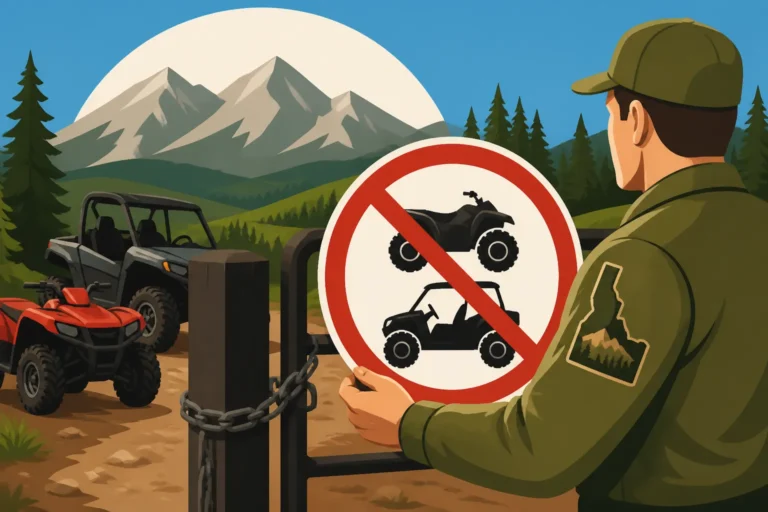
Gates and fences are often clear, physical indicators of private property or restricted access, even if they lack explicit "No Trespassing" signs. A closed gate typically means "do not enter," regardless of whether it's locked or simply latched. Opening a closed gate, driving through, and then closing it behind you still constitutes trespassing if the land is private.
On public lands, you might encounter "closed roads." These are different from private land. Public land roads can be closed seasonally for wildlife, habitat restoration, or logging operations. [Idaho Road Closures During Fire Season] These closures are often marked with signs or gates. Ignoring these closures can lead to fines, damage to fragile ecosystems, or even getting stuck in an impassable area. While aftermarket accessories like those from SuperATV can enhance your machine's capability with lifts, larger tires, or robust winches, using these modifications to bypass legitimate gates or signs on private or closed public land is not only illegal but irresponsible. No matter how capable your machine, respect for private property and land management rules must come first. The temptation to "just go around" a gate or closed sign can be strong, especially if it seems like a minor detour. However, doing so can damage sensitive environments, create new "unauthorized" trails, and erode trust between riders and land managers or private landowners.
Special Cases: Easements, Access Roads, and Agricultural Land
Idaho's rural landscape often presents more complex access situations beyond simple public/private distinctions. You might encounter what appear to be private roads that have public easements, meaning the public has a legal right to travel through them to access public lands beyond. However, determining if an easement exists and what its specific terms are (e.g., foot traffic only, motorized vehicles allowed) can be difficult. It typically requires checking county plat maps or official land records, or looking for very specific public access signage. Do not assume an easement exists without clear evidence.
Agricultural lands also present unique considerations. While Idaho has some exemptions for farm and ranch machines on roads, these typically apply to the landowners or those explicitly working the land for agricultural purposes. [Farm Exemptions From Idaho OHV Rules] Recreational OHV use on private agricultural land without explicit permission is trespassing. Riding near ranch land requires extra care; straying from a designated trail could easily lead to riding through pastures, disturbing livestock, or damaging irrigation systems, all of which will understandably infuriate a rancher. Always give livestock and farm operations a wide berth, and if you see active work, assume the area is entirely off-limits unless otherwise posted as a public trail.
Best Practices for Respectful and Legal OHV Riding
Preventing trespassing is far easier and less stressful than dealing with the consequences. By integrating a few key practices into your riding routine, you can ensure your adventures remain legal and enjoyable for everyone.
Always Know Before You Go: Pre-Ride Planning
The golden rule of OHV riding in Idaho, especially when tackling unfamiliar terrain, is "know before you go." This means diligent pre-ride planning that goes beyond just checking the weather.
Start with current maps. Always carry both digital maps (on a GPS device or smartphone app like onX Offroad) and a paper map as a backup. Digital maps allow for real-time tracking of your position relative to property lines, while a paper map is indispensable if your electronics fail or lose signal. Cross-reference these maps with official sources like Forest Service MVUMs or BLM recreation maps to understand what roads and trails are open to OHVs. For areas with particularly complex ownership or local ordinances, consider contacting the local Forest Service Ranger District, BLM Field Office, or even Idaho Parks and Recreation directly. They can provide clarity on specific routes or recent closures. Scouting your routes beforehand, perhaps via satellite imagery, can also help you spot potential boundary issues or unexpected barriers. Make a point of understanding any local city or county ordinances that might affect OHV use, as these can restrict road access or enforce quiet hours in certain areas. [What an Idaho Deputy Asks a Rider For]
Here's a simple checklist to help you stay on legal ground:
| Task | Purpose | Tools Recommended |
|---|---|---|
| Check MVUMs/BLM Maps | Identify open OHV routes on public land | Forest Service Website, BLM Website |
| Consult Private Property Maps | Delineate private parcels and their boundaries | onX Offroad, Gaia GPS |
| Review Local Ordinances | Understand any county/city specific OHV rules | County/City Website, Local Agencies |
| Check for Closures/Conditions | Verify trails are open, no fire bans, or seasonal restrictions | IDPR, Forest Service, BLM Websites |
| Scout Route (Satellite View) | Identify potential obstacles, unclear boundaries | Google Maps Satellite, Mapping Apps |
| Pack Physical Maps & GPS | Redundancy for navigation, especially in dead zones | Paper Maps, Dedicated GPS Device |
| Charge All Electronics | Ensure power for navigation devices | Portable Power Bank, Charged Phone |
Seeking Permission and Understanding Access Agreements
Sometimes, the best riding routes might briefly cross private land, or you might find a property you'd love to explore with permission. In these situations, the direct approach is often the most effective: politely ask for permission.
Approaching a landowner respectfully, explaining your intentions, and assuring them you will leave no trace can often open doors. A simple knock on the door, a phone call, or a letter can sometimes grant you access that would otherwise be off-limits. If permission is granted, it's wise to get it in writing, even if it's just a simple signed note outlining the agreed-upon access. This protects both you and the landowner. Avoid relying on "implied permission," such as seeing others ride a particular route for years. Property ownership can change, agreements can be revoked, or what seemed like implied permission might have been active trespassing all along. A local trail near my home used to cross a corner of a private ranch, and riders always assumed it was okay. Then the ranch changed hands, and the new owner, tired of trash and gates left open, clearly posted the area. What was once an informal understanding quickly became illegal trespassing. Always seek explicit permission.
The Role of OHV Clubs and Advocacy
Local OHV clubs and riding organizations play a vital role in maintaining and expanding access to riding areas. These clubs often work directly with land managers (Forest Service, BLM) and private landowners to maintain existing trails, clean up illegal routes, and even develop new ones.
Many clubs actively engage in trail adoption programs, where members volunteer their time to clear brush, repair washouts, and install signage, often in partnership with public land agencies. This dedicated stewardship helps ensure trails remain open and well-maintained. [Idaho OHV Clubs and Trail Adoption] By joining a local club, you not only connect with fellow riders but also contribute to the collective effort of preserving and advocating for responsible OHV access. Their knowledge of local trails, land ownership, and ongoing access discussions can be invaluable. Supporting these organizations helps demonstrate that OHV riders are responsible land users, which in turn helps keep more land open for everyone.
What to Do If You Suspect You've Trespassed (or Witness It)
Even the most cautious rider can occasionally find themselves in an ambiguous situation. Knowing how to react if you realize you've trespassed, or if you witness others doing so, is crucial for both your legal safety and the reputation of the OHV community.
If You Realize You've Crossed Posted Land
If, despite your best efforts, you realize you've ridden onto private or otherwise restricted land, the immediate priority is to stop, turn around, and leave the property in the most direct and respectful way possible. Do not linger, do not argue if confronted, and do not try to justify your presence.
Should a landowner or law enforcement officer approach you, remain calm, polite, and apologetic. Explain that you believe you made an error in navigation and are in the process of leaving. Provide your identification if requested and cooperate fully. Arguing, becoming defensive, or trying to evade the situation will only escalate the problem and likely result in harsher penalties. It's far better to accept responsibility for your mistake, however unintentional, than to turn it into a confrontation. Once you are safely off the posted property, take the time to review your maps and retrace your route digitally to understand where you went wrong. This documentation can help you avoid the same mistake in the future. [Idaho Trespass Law for Riders]
Reporting OHV Trespass and Land Damage
Witnessing others illegally riding on posted ground or causing damage can be frustrating, especially if you're a responsible rider who works to maintain access. Reporting these incidents is an important step in preserving legal riding opportunities and holding irresponsible individuals accountable.
If you observe OHV trespass or resource damage (like riding off-trail into sensitive areas or tearing up vegetation), contact the appropriate authorities. This could be the local county sheriff's office, the Forest Service, the Bureau of Land Management, or Idaho Parks and Recreation. [Reporting an OHV Trespass] Provide as many details as possible: the exact location, a description of the machines (make, model, color, any distinguishing features), the number of riders, the time of the incident, and the direction of travel. If you can safely take photos or videos without endangering yourself or violating anyone's privacy, these can be very helpful. Remember to report, not confront. Approaching individuals engaged in illegal activity can be dangerous. Your reporting helps law enforcement focus their efforts and demonstrates that the OHV community itself cares about responsible land use, which is critical for maintaining access to our beloved trails and roads.
Tools and Technology for Staying on Track
In today's world, technology offers powerful allies for staying on the right side of property lines and regulations. Beyond traditional paper maps, several digital tools can significantly enhance your ability to navigate responsibly.
GPS-enabled mapping apps like onX Offroad or Gaia GPS are invaluable. These apps allow you to download detailed basemaps (including satellite imagery, topo maps, and MVUMs) to your phone or dedicated GPS unit. Crucially, they often overlay private property boundaries and public land distinctions directly onto the map, showing your exact position relative to these lines. This means you can see, in real-time, if you're approaching a private parcel or a restricted area, even in remote locations without cell service. [Cell Service in the Idaho Backcountry] Always download your maps before you leave home, as cell service is spotty or nonexistent in much of Idaho's backcountry. Having a reliable mount for your GPS device or phone, such as those available from SuperATV, ensures your navigation tools are secure and visible, allowing you to quickly glance at your position and stay on track without fumbling for your device. Some riders even install dash cams on their machines. While primarily used for recording rides, they can also serve as an objective record of your route, useful for demonstrating compliance or understanding where an accidental turn might have occurred. Investing in these tools is a small price to pay for peace of mind and protection from trespassing charges.
Disclaimer
This article is for general informational purposes only and does not constitute professional advice. Laws, prices and regulations vary by location and change over time. Consult a qualified professional for guidance on your specific situation.