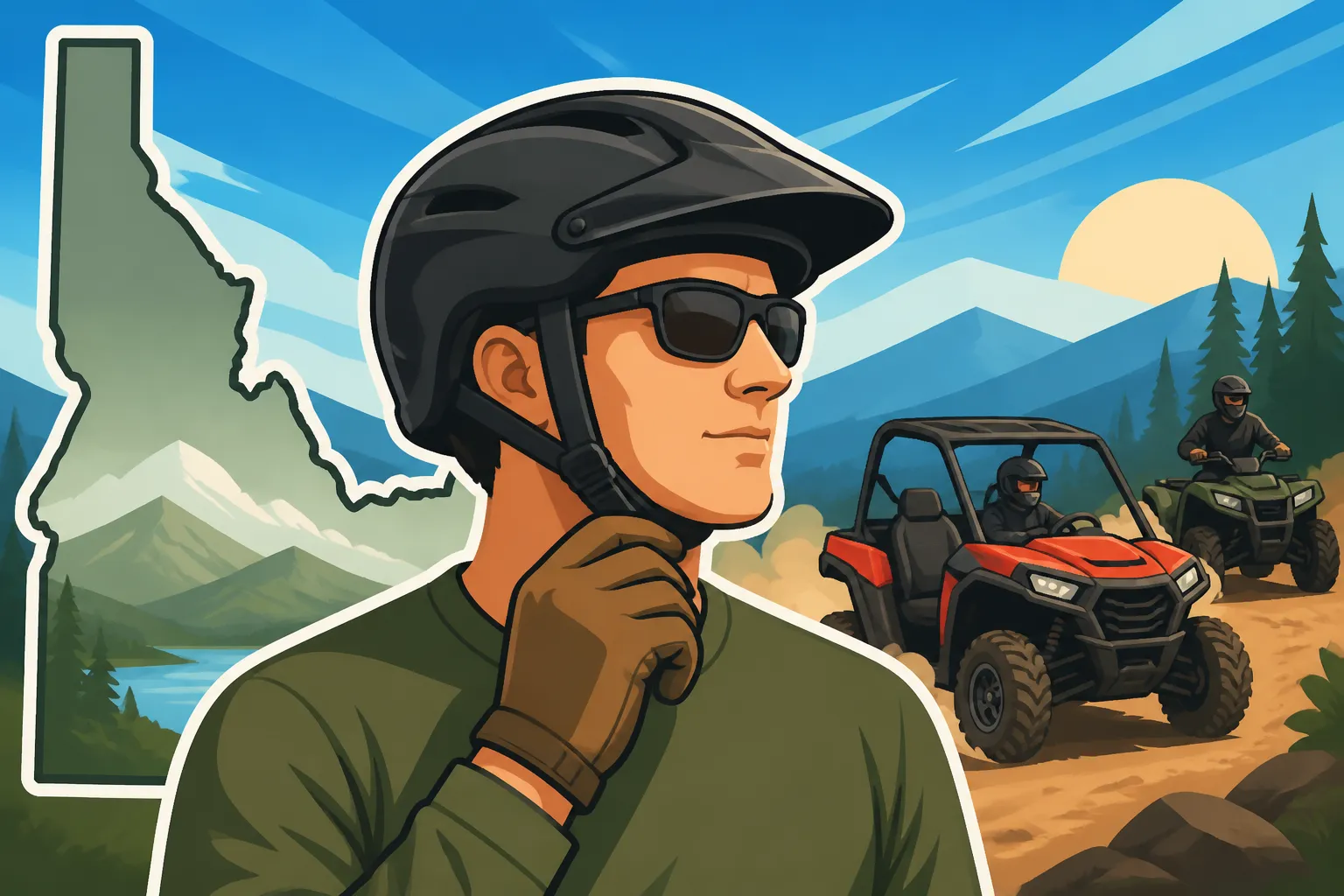
Helmets for Adults Who Are Not Required To
Idaho adults may be able to ride an ATV or UTV without a helmet under state law, but “not required” is not the same as “not worth wearing.” The choice affects more than comfort: fit, eye protection, weather, terrain and the type of machine all matter. Here’s how to understand the rule and make a practical decision for your next ride.
What Idaho’s helmet rule means for adults
Idaho state law does not mandate safety helmets for adult OHV riders age 18 and older; the Idaho State Legislature says the helmet requirement applies to operators and passengers under 18. That makes helmet use a personal safety choice for adults on ordinary rides, rather than a general state-law requirement.
That rule is easy to misread as a recommendation to ride bareheaded. It isn’t. A helmet can help protect your head during a fall, collision or rollover, but the law’s minimum requirement and a rider’s safety decisions are separate questions. A ride that feels routine can still involve uneven ground, loose gravel, other vehicles, low branches or a sudden stop.
The age rule is also important when an adult is riding with a young person. According to the Idaho Department of Parks and Recreation, riders under 18 must wear a DOT-approved helmet when operating an OHV off-highway. The requirement applies to young operators and passengers. For details about how age and helmet rules fit together, see Idaho Helmet Requirements Under 18 and Idaho Helmet Law for Riders Over 18.
There is a specific UTV exception in the information from the Idaho Department of Parks and Recreation: UTVs equipped with a roll cage and seat belts are exempt from the helmet requirement. That exception does not mean protective equipment is useless, and it does not automatically apply to every machine that a rider calls a side-by-side. Check that the vehicle and riding situation meet the applicable rule rather than assuming any UTV is exempt.
A training course can also have its own equipment requirements. The Idaho Department of Parks and Recreation requires a DOT-approved helmet during its Responsible Riders training, even though adult helmet use is not generally mandated by state law for ordinary riding. So an adult attending training should plan to bring a helmet and follow the course instructions. The course’s other required gear includes eye protection, over-the-ankle boots, OHV-type gloves, long pants and a long-sleeved shirt or jacket.
| Situation | What to know |
|---|---|
| Adult riding an OHV | Idaho state law does not mandate a helmet for adults age 18 and older, according to the Idaho State Legislature. |
| Rider or passenger under 18 | The Idaho Department of Parks and Recreation says a DOT-approved helmet is required off-highway. |
| UTV with a roll cage and seat belts | The Idaho Department of Parks and Recreation identifies these UTVs as exempt from the helmet requirement. |
| Responsible Riders training | The Idaho Department of Parks and Recreation requires a DOT-approved helmet during training. |
This is a useful starting point, not a substitute for checking the rules for the particular road, land or activity. If you’re unsure whether an age-related requirement or a vehicle exception applies, review Idaho Helmet Standards and Who Must Wear One and confirm with the relevant official source before riding.
Why wearing a helmet can still be the sensible choice
The law sets a minimum. Your risk depends on where you ride, how you ride and what you are operating. A helmet is one part of reducing the chance of a serious head injury; it does not make a risky maneuver safe, and it cannot prevent every injury.
Think about what a normal ride can involve. You may encounter a rut you did not see, lose traction on a slope, take a branch across your path or need to brake quickly on a narrow trail. A passenger can face many of the same hazards as the operator. Riding more slowly and leaving room to react can help, but those steps do not replace protective equipment.
The argument for wearing a helmet is especially strong when the route is unfamiliar, the terrain is rough, visibility is limited or the group includes less experienced riders. Conditions can change over the course of a ride, too. A smooth road out of the staging area may lead to a more demanding route, and a minor incident can still result in a hard impact.
An open ATV and a UTV also create different riding environments. An ATV rider is exposed and sits astride the machine. A UTV may provide a roll cage and seat belts, which change how its occupants are restrained, but that does not make every rollover or collision harmless. The Idaho Department of Parks and Recreation’s stated exception for a UTV with a roll cage and seat belts concerns the helmet requirement; it should not be read as a guarantee that occupants cannot be hurt.
Other protective gear matters alongside a helmet. The Idaho Department of Parks and Recreation says riders must wear goggles or a face shield in the circumstances covered by its rider guidance, and its eye-protection information specifies lenses bearing z87.1 or VESC 8 (V-8) markings, or made of hard-coated polycarbonate. For help choosing suitable eye protection, see Eye Protection That Meets the Rules.
Even when adult helmet use is optional under state law, it can be a straightforward choice: wear one if you want added protection, if the ride includes challenging conditions, or if you would rather not make helmet use depend on a last-minute judgment call. Passengers may also appreciate a consistent group rule, particularly when riders are sharing a machine or changing seats during a trip.
Choosing and wearing a helmet for an Idaho ride
A helmet only helps as intended when it fits properly and is appropriate for the kind of riding you plan to do. Look for a model that is designed for powersports use and meets the relevant safety standards. Idaho’s stated requirements for minors and Responsible Riders training specify a DOT-approved helmet; adults who choose to wear one can use that as a practical baseline.
Fit matters. A helmet should sit level and feel secure rather than rocking or sliding around when you move your head. It should not create painful pressure points, and the fastening system should stay secured when the helmet is worn. If the fit is uncertain, trying helmets on in person can be more useful than choosing by appearance or relying on a size label alone.
Consider the riding conditions as well. A full-face design can provide more coverage around the face than an open-face design, while an open-face helmet may feel less enclosed. The right choice involves a trade-off among coverage, comfort, ventilation and the type of eye protection you use. Whatever style you choose, make sure goggles or a face shield work with the helmet and stay in place during movement.
Buying online can be convenient, but it adds a fit risk. If you shop through Amazon or another online retailer, check the manufacturer’s sizing guidance and return conditions before ordering, and avoid assuming that a familiar size will fit every helmet model the same way. A loose or uncomfortable helmet is less likely to be worn consistently.
Before a ride, inspect the helmet for visible damage and make sure its retention system works. If it has been involved in a significant impact, follow the manufacturer’s guidance about whether it should be replaced. Do not modify the shell or fastening system in a way the manufacturer does not approve. A helmet that has been altered or no longer fits securely may not provide the protection you expect.
A practical gear check can help avoid discovering a problem at the trailhead:
- Confirm the helmet fits and its fastening system is secure.
- Check that goggles or a face shield are compatible and comfortable.
- Bring the rest of your riding gear, including gloves, sturdy footwear and clothing suited to the conditions.
- Make sure every under-18 rider or passenger has the required helmet.
- If attending Responsible Riders training, follow the Idaho Department of Parks and Recreation’s equipment list.
For a broader checklist that includes permits and other preparation, see What Idaho Riders Need Before They Ride. The helmet is only one part of readiness; it does not replace checking your machine, route conditions or access rules.
Make the choice before you reach the trail
The practical answer is simple: Idaho does not generally require adults to wear an OHV helmet, but an adult can still choose to wear one for added protection. Decide before the ride begins, when you can check fit and make sure the helmet works with your eye protection. If you ride with younger people, keep their legal requirements separate from your own choice.
Do not assume every trip follows the same rule. A training course can require a helmet even when adult use is otherwise optional, and the Idaho Department of Parks and Recreation identifies a specific helmet exception for UTVs equipped with roll cages and seat belts. When your situation does not clearly match one of those cases, verify the rule with the appropriate official source.
Helmet use also fits into a larger safety routine: choose a route suited to the group, use protective clothing, ride within your abilities and stop if conditions become unsafe. If the group is deciding what to require, a consistent rule that everyone wears a properly fitted helmet may be easier to follow than making different decisions for each machine or trail.
For related guidance on standards, age requirements and protective gear, see Idaho Helmet Standards and Who Must Wear One and Idaho Helmet Requirements Under 18. The key distinction is that legal permission to ride without a helmet as an adult does not mean riding without one is the safest choice.
Sources
- Department of Parks and Recreation — Trail Ranger Application | Department of Parks and Recreation (checked November 3, 2026)
- Idaho Department of Parks and Recreation — ID_OHV_LE_Guide.pdf (checked November 3, 2026)
- Idaho Department of Parks and Recreation — OHV_BOOKLET.pdf (checked November 3, 2026)
- Idaho State Legislature — H0013E1 (checked November 3, 2026)
Disclaimer
This article is for general informational purposes only and does not constitute professional advice. Laws, prices and regulations vary by location and change over time. Consult a qualified professional for guidance on your specific situation.