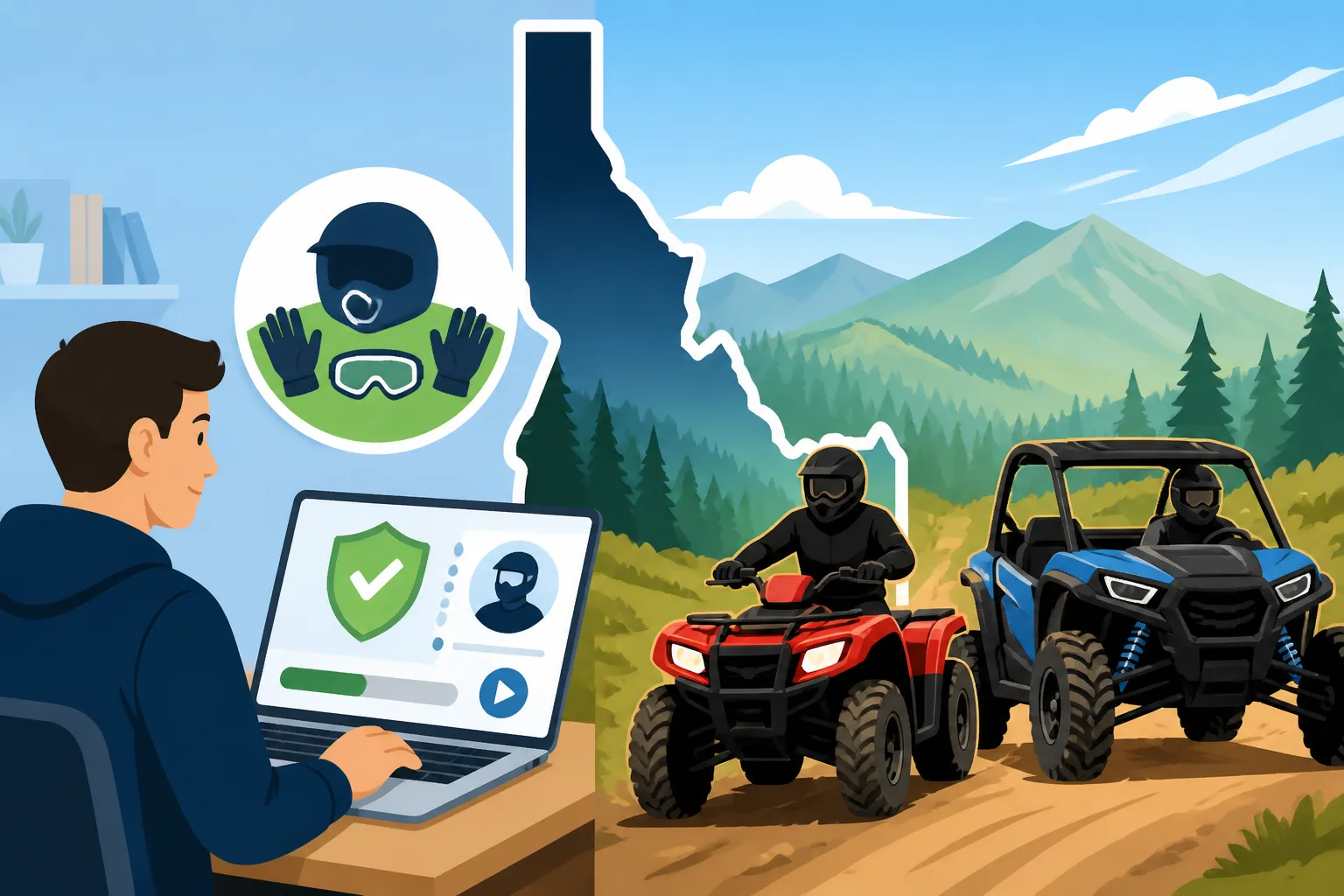
Taking the Safety Course Online
Taking Idaho’s OHV safety course online can be a convenient way to prepare a young rider, but finishing the course does not automatically satisfy every riding rule. The important steps are choosing an Idaho-accepted course, confirming who needs it, and understanding what the certificate does—and does not—allow on trails and roads.
What the online course does and who may need it
An online OHV safety course teaches riders basic operating practices and safety principles. Depending on the course, it may cover controls, protective equipment, riding within your ability, trail awareness, and how to respond to hazards. The course can help a new rider prepare, but it is not a substitute for hands-on practice or direct supervision where those are required.
In Idaho, whether a rider needs a safety certificate depends on factors such as age and where the machine will be operated. The rules for a public forest road may not be identical to the rules for another riding area. Before enrolling, check Who Must Take the Idaho Safety Course and Idaho’s Forest Road Rule and the Safety Course so you are solving the right problem rather than assuming every rider has the same requirement.
A certificate is also different from an OHV sticker, registration, or restricted vehicle plate. It documents completion of safety education; it does not register the machine or grant road access. For the wider set of requirements riders may need to meet, see Idaho OHV Safety Course Requirements and What Idaho Riders Need Before They Ride.
| Question | What to confirm |
|---|---|
| Does this rider need a course? | Check the rider’s age and the rules for the specific place and type of riding. |
| Is the online course accepted in Idaho? | Verify that the provider and course meet Idaho’s current acceptance requirements. |
| Does the certificate allow unsupervised riding? | Check the supervision rules that apply to the rider and location. |
| Does it authorize road use? | No. Road access depends on separate vehicle, equipment, and local-road requirements. |
| Does it replace an OHV sticker? | No. Confirm the machine’s sticker or registration requirements separately. |
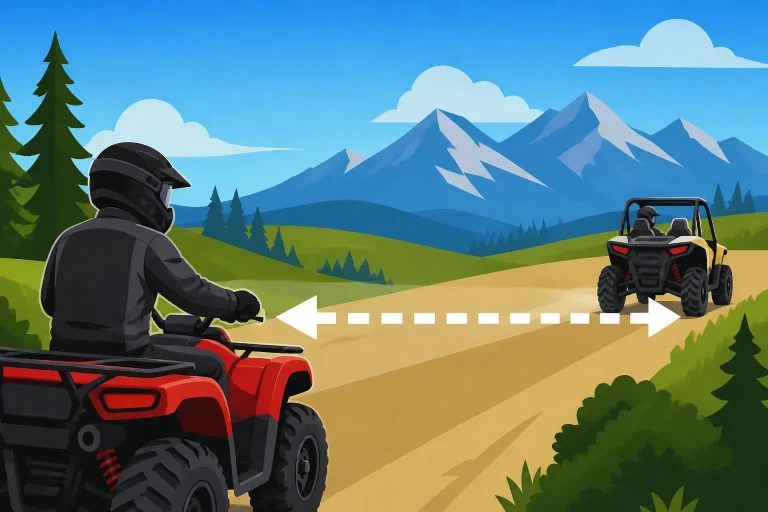
Do not assume that completing the course removes an age-based supervision requirement. Idaho has rules concerning supervision of young riders, including a distance rule in some situations. Read Idaho Supervision Rules and the 300-Foot Rule before planning a ride, and confirm that the adult accompanying the rider can meet the applicable requirements.
The course may still be worthwhile even when a rider is not required to take it. A young person can become familiar with basic safety concepts before getting on a quad or side-by-side, while a parent or guardian can use the material to start conversations about speed, terrain, passengers, and trail etiquette. But a quiz passed online cannot establish that a rider can control a particular machine on a slope, stop safely on loose ground, or recognize when conditions are beyond their ability.
How to take the course online
1. Check the current eligibility and acceptance rules
Start with Idaho’s official OHV safety information or the state-approved course provider. Confirm that the course is accepted for Idaho use, and check its minimum age, registration process, and certificate format. A course that is reputable in another state is not automatically accepted for every Idaho requirement.
Age limits can apply to taking the online course itself, separate from the age rules for riding. If a child is younger than the provider’s minimum, ask whether there is another approved option or whether an adult should complete a different form of instruction. The course’s eligibility rules are not the same thing as Idaho’s general operating rules. See Minimum Age for the Online Course for the age question and confirm current details with the provider before starting.
2. Register using the rider’s information
Use the name and other details the provider requests for the person taking the course. If a parent or guardian is helping, make sure the learner—not the supervising adult—is the person completing the lessons and assessment when the course is intended to certify the rider.
Before starting, check whether the provider lets students pause and resume. Set aside enough time to work through the lessons attentively rather than clicking through them while distracted. If the course includes a final test, a rider who rushes may miss practical safety points that matter more than the certificate itself.
3. Complete the lessons and assessment
Work through each section, including any embedded questions or practice checks. Keep the learner engaged with real examples: how the controls on the family’s machine work, why passengers must have appropriate seating, and what to do if a route becomes steep, muddy, or crowded.
The course is a starting point, not a machine-specific operating lesson. A rider should also learn the controls and safety features of the actual ATV or UTV before riding. For a side-by-side, that includes seat belts and other occupant restraints; for a quad, it includes understanding how the rider’s body position affects control. Follow the owner’s manual and the adult’s instruction for the specific machine.
4. Save the certificate and verify what it proves
After passing, follow the provider’s directions to obtain the certificate or completion record. Download or print it if that option is available, and save a digital copy somewhere accessible to the parent or guardian. Check the rider’s name and completion details for errors before relying on the document.
Ask the provider or the appropriate Idaho agency whether the certificate must be carried while riding, whether an electronic copy is acceptable, and whether it expires or needs renewal. Requirements can depend on the course and the situation. The article Carrying a Safety Certificate explains the practical question of keeping proof available, while Does a Safety Certificate Expire? addresses how to check its continuing validity.
Keep a copy with the family’s riding paperwork, but do not treat it as a replacement for vehicle documents. The machine may have separate title, registration, sticker, insurance, or road-use requirements. A certificate also does not guarantee that every land manager, event organizer, or rental operator will accept it for their own rules.
What the certificate does not cover
It does not replace supervision
A certificate should not be treated as permission for a young rider to go alone. Supervision requirements may depend on the rider’s age and the riding location, and completing a course does not necessarily change those requirements. Review the rules for the specific place before setting out, especially if the ride includes a forest road, a public trail, or a section open to other traffic.
A responsible adult should remain close enough to respond if the young rider has trouble, and should choose terrain that matches the rider’s ability. The adult also needs to make sure the machine is appropriately sized and that the rider can reach and operate the controls safely. Course completion is no substitute for those decisions.
It does not authorize riding on a road
Public-road riding is a separate question from OHV safety education. A course certificate does not make a road open to OHVs, convert an ATV into a road-legal vehicle, or satisfy equipment and operator requirements. Before riding any road section, determine whether that specific road is open and what conditions apply. What Idaho Requires to Ride a County Road and Idaho’s Restricted Vehicle Plate and Road Use cover separate requirements that a course cannot replace.
Road access can also differ by jurisdiction. A county or city may restrict or close a road even if a route appears usable on a map. Confirm current local access rather than relying on a rider’s certificate, a familiar route, or another person’s past experience.
It does not settle sticker or permit questions
An OHV sticker or permit is separate from safety training. The machine may need the appropriate sticker for the land or riding situation, and a visitor’s out-of-state registration may not answer every Idaho permit question. A safety certificate does not act as proof that the machine has the required sticker.
If you are preparing for public-land riding, check the machine’s permit status as well as the rider’s training. Idaho Permit Rules on Public Land explains the distinction, and Idaho’s Non-Resident OHV Sticker is useful for visitors bringing a machine from another state. Do not assume that a certificate, a plate, and a sticker are interchangeable documents.
It may not settle out-of-state acceptance
A rider who completed an OHV course elsewhere should not assume Idaho will accept that certificate for every purpose. Acceptance can depend on the course and the requirement involved. Check with Idaho’s official program or the relevant land manager before travel, and retain the certificate details so the course can be identified. See Out-of-State Certificates Idaho Accepts for this specific issue.
Likewise, an Idaho certificate may not automatically meet another state’s rules. If a trip crosses a state line, check the destination’s safety education and operating requirements rather than relying on Idaho completion alone.
A practical checklist before the first ride
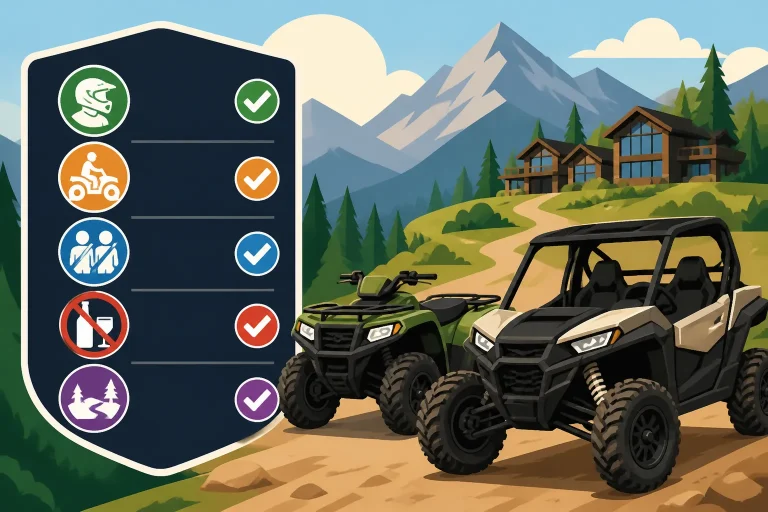
After the online course is complete, use this checklist to turn the certificate into part of a safe, legal plan:
- Confirm the course is accepted. Check with the official Idaho program or provider, particularly if the course was taken outside Idaho.
- Verify the rider’s age-related rules. Do not infer that the certificate changes supervision requirements. Review Idaho Age Rules for Riders Under 16 and the location-specific rules.
- Match the machine to the rider. Make sure the rider can reach the controls, understand how the machine behaves, and operate it without being overwhelmed.
- Practice in a controlled setting. Start with basic controls and low-risk conditions before moving to unfamiliar trails or uneven terrain.
- Use appropriate protective equipment. Follow Idaho’s applicable helmet and eye-protection rules, and use suitable gear for the ride. A safety lesson does not replace protective equipment.
- Check machine paperwork separately. Confirm the required sticker or registration, and carry any documents required for the planned ride.
- Check the route and current restrictions. A course does not provide trail access. Verify that the route is open to the machine and rider, including any road sections.
- Keep proof of completion accessible. Save the certificate and confirm whether it must be carried and whether it remains valid.
This preparation matters because a family ride can combine several different rule sets: youth operation, land access, road use, equipment, and machine registration. The online course addresses only the safety-education part. Treat it as one item in the pre-ride check rather than the final authorization to ride.
If a rule or certificate detail is unclear, ask the Idaho program or the land manager responsible for the route before heading out. That is especially useful when a rider is near an age threshold, the certificate came from another state, or the trip includes a road open to local traffic. Confirming the requirement ahead of time is easier than trying to resolve it at a trailhead or during a stop.
Disclaimer
This article is for general informational purposes only and does not constitute professional advice. Laws, prices and regulations vary by location and change over time. Consult a qualified professional for guidance on your specific situation.