Enforcement and Checkpoints in Idaho
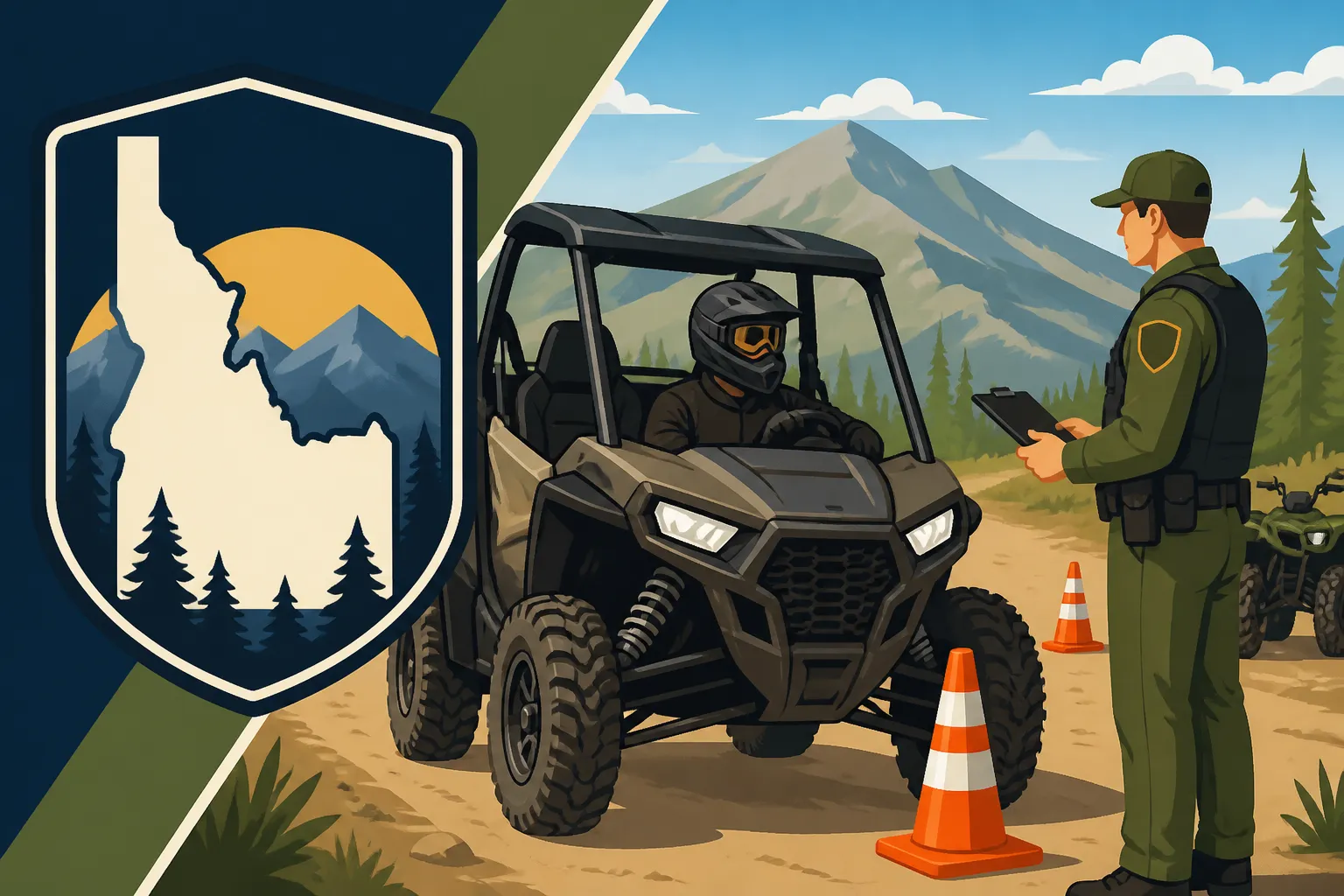
A stop or checkpoint can interrupt an Idaho ride, especially when a machine crosses from a trail onto a road or riders come from another state. Knowing what officers may check—and having the right paperwork and equipment ready—can make the interaction straightforward. The key is to understand that a sticker, plate, or safety certificate does not automatically allow every kind of riding.
Who May Conduct a Stop or Checkpoint
The person checking your machine may be a law enforcement officer or an official responsible for managing the land where you are riding. Depending on the location and circumstances, that could include a county deputy, a state officer, or an officer assigned to public land. Different agencies have different responsibilities, and more than one set of rules may apply on a single ride.
On public land, officials may check whether the machine and rider meet Idaho requirements and whether the route is open to motorized use. Federal land managers may also enforce restrictions that apply to the land they manage. A machine can be properly registered and still be on a closed route, outside an approved riding area, or operating in a way that violates a land-use restriction.
On a county road, the question is not only whether the machine has a sticker. The road must allow the kind of OHV use you are making, and the machine must meet any requirements that apply to that road. Local ordinances can affect which roads are open. A restricted plate does not make every public road available to OHVs. See What Idaho Requires Before You Ride a County Road and Idaho’s Restricted Vehicle Plate and Road Use for the distinction between machine credentials and road access.
Stops may happen during ordinary patrols, at a temporary checkpoint, near a staging area, or after an officer observes a possible violation. A checkpoint can be set up to check compliance, address a particular safety or access concern, or manage use in a busy area. Its presence does not necessarily mean you have been accused of an offense.
Keep the interaction calm and practical. Stop in a safe place, follow instructions, and avoid reaching into a bag or compartment without explaining what you are doing. If an officer asks for a document, say where it is before you retrieve it. If you do not understand a question or believe a rule is being applied incorrectly, you can ask for clarification politely. A roadside disagreement is rarely the best place to argue the details of a rule.
What Officers May Check
A compliance check can cover several separate questions: whether you are allowed to operate the machine, whether the machine is properly identified and marked, whether you are riding on an open route, and whether the equipment is suitable for the type of travel. What matters depends on the land, route, machine, rider, and circumstances.
| Check area | What may be relevant | A useful preparation |
|---|---|---|
| Sticker or registration | Whether the machine has the required Idaho credential for its status and use | Check that the credential is current and displayed as required |
| Plate and road use | Whether the machine is equipped for a road section and the road is open to OHVs | Confirm local road access before the ride |
| Rider eligibility | Age-related requirements, supervision, and any required safety course | Know which rules apply to each rider and carry required proof |
| Route and land rules | Whether the trail or road is open and whether motorized travel is allowed there | Check current maps, signs, and closures |
| Safety equipment | Required or appropriate equipment for the machine, rider, route, or conditions | Inspect the machine and rider gear before leaving |
| Conduct | Safe operation, passengers, speed, and compliance with posted restrictions | Ride predictably and follow signs and officer directions |
Stickers and registration
Officials may ask whether your machine has the appropriate sticker or registration for your situation. Idaho residents and visitors may have different requirements, and the rules can depend on where and how the machine is used. A credential that applies to one rider or machine does not necessarily cover another machine in the group.
Do not assume an old sticker remains valid just because it is attached, or that a purchase receipt is a substitute for a required credential. Check the relevant dates and the placement rules before leaving home. These topics are covered in Idaho OHV Registration Runs January to December, Idaho’s Non-Resident OHV Sticker, and Where Idaho Sells OHV Stickers.
A sticker answers only part of the question. It does not establish that a particular road or trail is open, that the rider meets age or course requirements, or that a machine has the equipment needed for road use. Treat those as separate checks.
Plates and roads
If your route includes a road, an officer may want to know whether the machine is allowed on that particular road and whether it has the required road-use equipment or credentials. A route that looks like a public road on a map may be closed to OHVs, subject to a local restriction, or managed under rules different from the trail you just left.
A restricted plate can be part of road-use compliance, but it is not blanket permission to ride on any road. A rider still needs to know which roads are open and follow applicable conditions. For a closer look at the credential itself, see What Idaho’s $3 Restricted Use Plate Covers. For sticker display, see Displaying a Sticker on an Idaho R Plate.
Riders, supervision, and safety course requirements
A stop can include questions about a young rider’s age, supervision, or required safety education. Requirements can vary with the rider’s age and the type of riding or road involved. Do not assume that a young rider who is permitted on a family property can ride alone on a public trail or road under the same conditions.
Check the applicable rule for the planned ride before departure, especially if a group includes children or teenagers. If a safety certificate is required, make sure the rider has completed the appropriate course and can show proof when needed. Idaho’s OHV Safety Course for Young Riders and Idaho Supervision Rules and the 300-Foot Rule explain two areas that deserve particular attention.
Routes, closures, and land restrictions
Officials may check whether you are following the designated route and respecting closures, signs, barriers, and seasonal limits. A route shown on an older map may have changed. A trailhead sign or current closure notice can be more important than a saved route file when conditions or access rules have changed.
A valid sticker does not override a closure. Nor does permission to ride on one parcel automatically permit riding across neighboring property. On mixed public and private land, be alert to signs and boundaries, and do not ride around a gate or barrier unless the managing authority has clearly indicated an approved route.
How to Prepare for a Checkpoint
The easiest checkpoint is one where you can answer basic questions without unloading the machine or searching through a phone with gloves on. Before the ride, work through these steps:
- Identify every machine and rider. Note who is operating each ATV or UTV, whether any machines are borrowed or rented, and which riders may have age-related requirements. Avoid assuming that one credential covers the whole group.
- Confirm the credential that applies to each machine. Check the machine’s Idaho sticker or registration status and any plate needed for the planned road use. If you are visiting from out of state, verify the nonresident requirements rather than relying on a home-state document alone.
- Check the route, not just the destination. Look at current route information and local restrictions for each road or trail segment. A ride may cross different jurisdictions or land managers, so confirm the route from start to finish.
- Gather required proof. Carry any documents or certificate that the rider may be required to show. Keep them accessible but protected from water, mud, and damage.
- Inspect the machine and gear. Check that required equipment is present and working for the planned use. Pay particular attention when the ride includes a road section, travel after dark, or conditions that may reduce visibility.
- Brief the group. Agree on what to do if the group is stopped or separated. Riders should know to stop safely, stay with their machines, and follow an officer’s instructions.
A simple document pouch can keep papers together, but avoid storing anything in a place that makes it unsafe to retrieve. A small waterproof pouch bought at an outdoor retailer or through Amazon may work for paperwork, provided it stays secure and does not interfere with riding. Do not carry original documents where a fall, water crossing, or ordinary trail damage could destroy them if an acceptable alternative is available.
Make documents easy to show
There is no advantage to scattering documents among several riders’ bags. Keep the machine’s paperwork with the machine or with the person responsible for it, and keep a rider’s personal documents where that rider can access them. If one person is carrying paperwork for several machines, make sure the information is clearly separated.
Do not hand over a phone unlocked with unrelated personal information visible if a document can be shown directly. Open the relevant item before reaching the checkpoint when practical, and keep the screen readable. A paper copy may be useful as a backup, but it does not replace an original or required proof if the rule calls for something specific.
For information about the types of documents that may be relevant to a machine’s ownership and title, see Keeping Paperwork on the Machine. A title is an ownership document; it is not the same as an OHV sticker or permission to ride a particular route. In general, carry only the documents required for the trip and store them securely.
If a credential is missing or unclear
Do not try to improvise an explanation by presenting a credential that belongs to a different machine or rider. Tell the officer what you have and what is missing. If you are unsure whether a document meets the requirement, be direct rather than guessing.
A missing credential may have consequences, and the result can depend on the facts and the applicable rule. An officer may explain what is required or issue a citation. If you receive a citation, read it carefully and note any instructions or deadlines. Questions about a specific citation should be addressed through the process named on the citation or with a qualified professional. Do not assume that explaining the problem at the roadside will cancel a violation.
What to Do During a Stop
A steady, respectful response helps keep a routine check from becoming more difficult. Signal and pull over when safe, avoid blocking a trail or road, and shut off the machine if instructed. If the location is narrow or exposed, move only as directed or to a safe nearby spot. Do not ride away simply because you believe the stop is mistaken.
Keep your hands visible and tell the officer before reaching for a document, storage box, or phone. If several riders are present, one person should answer for the group when appropriate; a crowd of people talking at once can make a simple exchange confusing. Passengers should stay seated or stand where the officer directs.
Answer questions accurately. If you do not know an answer, say so rather than making one up. If a question is unclear, ask what information the officer needs. You can ask why the group has been stopped, but keep the question calm and brief. Do not interfere with the officer’s work or attempt to debate every detail while other riders are waiting.
If you disagree with an instruction or believe the stop is unlawful, avoid escalating the situation. Follow lawful directions and make a note of what happened afterward, including the location, time, officer or agency information if available, and any paperwork provided. A citation or formal notice should explain what response options are available. Use those channels to contest an issue rather than trying to resolve it through confrontation.
If the officer identifies a safety problem, such as a light not working or a machine being used on a road that is not open to OHVs, ask what action is required before continuing. Do not assume that a warning means you can keep riding in the same way. If you need to leave the route, do so only in a way that is permitted and safe.
Common Reasons Riders Run Into Trouble
Many problems at a stop begin with an understandable assumption: “I have a sticker, so I can ride here.” In practice, a sticker, road-use credential, rider qualification, and route permission answer different questions. Checking each one separately is more reliable than treating any single document as an all-purpose pass.
Treating the sticker as road permission
A sticker can show that a registration or permit requirement has been addressed, but it does not prove that a particular county road is open to OHVs. Local restrictions and road-specific rules still matter. Before planning a ride that links trails with town streets or county roads, check the route and the applicable ordinance. See Which Idaho County Roads Allow OHVs and Finding an Idaho County’s OHV Ordinance.
Assuming a home-state credential is enough
Visitors may expect their home-state registration or permit to be accepted everywhere. Idaho’s nonresident requirements need to be checked independently, and another state’s document may not meet them. Confirm the current rule before travel and buy or obtain the credential through an authorized channel if required. Why Idaho Ended OHV Reciprocity explains why riders should not rely on an old assumption that one state’s sticker automatically works in another.
Following an old map or an informal route
A route in a saved GPS file, online post, or paper map can be outdated. Routes may be closed, seasonally restricted, rerouted, or limited to certain vehicle types. Check current information and respect posted signs even when they differ from a route downloaded earlier. Reading an Idaho Motor Vehicle Use Map can help riders understand a useful route-planning tool, while Checking Idaho Trail Status Before You Drive covers the importance of checking conditions before setting out.
Mixing up title, plate, and sticker
A title documents ownership; a registration sticker addresses a different requirement; a plate may be relevant to road use. One does not automatically replace the others. Riders buying, borrowing, or transporting a machine should make sure they know which credentials apply to that specific machine and use. For the common misunderstanding about plates, see Why an Idaho Plate Is Not a Registration on Its Own.
Relying on another rider’s paperwork
A friend’s sticker, safety certificate, or other document does not necessarily satisfy the requirements for the machine or person being checked. Make sure each rider and machine is covered as required. This is especially important when a group includes rentals, borrowed machines, or visitors who brought their own equipment.
Ignoring equipment or conduct
A machine can have its paperwork in order and still be stopped for unsafe operation, equipment issues, or failure to follow posted rules. Carrying a passenger on a machine not designed for one, riding beyond the allowed route, or ignoring a closure can create problems that a sticker cannot solve. Review the rules for the particular road or trail and use the machine as designed.
A Short Pre-Ride Compliance Check
Before leaving the staging area, take a minute to check the items most likely to matter during a stop:
- The machine has the credential required for its registration status and planned use.
- Any plate needed for the planned road section is present and displayed as required.
- The route is open to the machine, and local restrictions have been checked.
- Each rider meets applicable age, supervision, and safety-course requirements.
- Required documents or proof are accessible and protected.
- Lights and other relevant equipment work, especially for a road section or low-light travel.
- Riders know what to do if the group is stopped or separated.
This check will not guarantee that you will never be stopped or cited. It does reduce avoidable confusion and helps riders catch problems before they are far from a staging area. If the ride crosses several counties or different kinds of public land, check requirements for each part instead of assuming that the starting point’s rules apply throughout.
When rules appear to conflict, use current information from the agency or land manager responsible for that road or area. Ask a specific question about the exact machine, route, and intended use. “Can I ride this road?” is easier to answer when you can identify the road segment, the machine type, and the credential you have.
Frequently Asked Questions
Can an officer stop an OHV rider at a checkpoint in Idaho?
A rider may encounter a stop or checkpoint during a ride. The reason and the rules that apply depend on the location and circumstances. Follow instructions, keep the interaction respectful, and ask for clarification if you do not understand what is being checked.
Does an Idaho OHV sticker mean I can ride on any road?
No. A sticker does not automatically make every road open to OHVs or satisfy every requirement for road use. Check whether the specific road is open and whether your machine needs additional credentials or equipment.
Should I carry my OHV title on the trail?
A title is an ownership document and is not the same as a sticker or road-use credential. Check which documents are required for your situation, and store any paperwork you carry so it is protected and accessible.
What should I do if I receive a citation?
Read the citation and follow the instructions and deadlines printed on it. Keep a copy and record relevant details about the stop. If you want to dispute it, use the stated process or consult a qualified professional.
Disclaimer
This article is for general informational purposes only and does not constitute professional advice. Laws, prices and regulations vary by location and change over time. Consult a qualified professional for guidance on your specific situation.